


FAQ
About IERE—Organization, Mission, and History
Overview and Purpose
Q.
What kind of organization is IERE?


A. Established in 1968, IERE is a non-profit, membership-based international organization that serves as a platform for decision-makers and experts in the electric power and energy sectors to exchange knowledge and collaborate in research and development. URL
Q.
What does "IERE" stand for?
A. "IERE" originally stood for International Electric Research Exchange, the organization's name at the time of its founding in 1968. Today, the official name is simply "IERE."
Q.
What is IERE's mission?
A. Our mission is to support our members in formulating R&D strategies that promote the evaluation and implementation of innovative technologies for safe, sustainable, affordable, and resilient power systems. URL
Q.
What is IERE's vision?
A. We aim to be a unique global platform that connects members worldwide and enables the exchange of expertise and advanced technologies. URL
Q.
How many members does IERE have?
A.
As of January 2026, IERE has 55 corporate and institutional members.
Note: Membership is granted on a corporate/institutional basis. Employees of member organizations can be authenticated through their domain (e.g., @iere.jp) and gain access to exclusive content and services.
Q.
What distinguishes IERE from other similar organizations?
A. IERE is a member-based organization engaged in R&D for the electric power industry, covering a broad scope from power generation to transmission, distribution, and retail. A distinctive feature is the concentration of its members in Asia, where significant growth is expected. While the membership size is not large, this fosters close collaboration among members. URL
Activities and Member Benefits
Q.
What kind of activities does IERE carry out?
A. IERE promotes the sharing of information and knowledge among members through activities such as forums, workshops, webinars, collaborative research projects, technology foresight studies, and international collaboration.
Q.
What are the benefits of joining IERE?
A. Members gain access to the latest technologies and R&D insights, opportunities to share expertise within an international network, and participation in collaborative research projects. IERE provides valuable information to senior executives, planning divisions, R&D departments, and operational units of member organizations, while also offering opportunities for collaborative problem-solving.
History
Q.
Could you briefly explain the history of IERE?
A. Since its establishment in 1968, IERE has developed as a non-profit international organization dedicated to advancing electric power technologies through global cooperation. Initially, it was a gathering of electric power-related organizations from industrialized countries. In 2000, IERE was restructured into a membership organization, welcoming electric utilities from developing countries as well as manufacturers and research institutes. While maintaining its founding purpose, IERE has continued to expand and diversify its activities.
Membership and Global Outreach
Q.
What types of organizations make up IERE's membership?
A. Members include major electric utilities, manufacturers, research institutes, universities, and other organizations engaged in the energy sector worldwide.
Governance and Organizational Structure
Q.
How is IERE managed?
A. IERE’s policies and strategies are determined by the Board, while day-to-day operations are handled by the IERE Central Office.
Q.
Who are the members of the Board of Directors?
A. The Board consists of representatives elected from among Executive members.
Q.
Could you explain IERE's organizational structure?
A. IERE’s decision-making is carried out by the Board, while the Central Office manages the implementation of activities. In addition, a General Meeting of all members is held once a year, where the Board’s decisions and important activities are reported.
Q.
Where is the Central Office located?
A. The Central Office is located in Komae city, Tokyo, Japan. It is responsible for supporting and facilitating IERE’s activities, as well as administrative operations.
Financial and Legal Information
Q.
As a non-profit organization, how does IERE fund its activities?
A. IERE is funded mainly through membership fees and event-related income, and it operates on a non-profit basis.
Q.
Where can I find IERE's Statutes and Bylaws?
Membership Benefits, Eligibility, and Application
Membership Benefits
Q.
What are the benefits of becoming a member?
A. Benefits include networking with other members through participation in in-person meetings such as forums and workshops, access to and sharing of members-only technical information, and opportunities to take part in collaborative research projects.
Q.
What does "information access and sharing" mean in this context?
A. It refers to access to members-only resources such as the latest technical information, research reports, and seminar materials, as well as the exchange of information among members.
Q.
What content is restricted to members only?
A. Non-members cannot participate in members-only projects, access restricted documents, or attend certain meetings.
Q.
How can I access information?
A. Information is posted on the IERE website. In addition to publicly accessible materials, the site includes a variety of members-only content. Access requires a member ID and password, which can be set up by following the instructions on the IERE website.
Q.
How can I contribute to IERE's activities?
A. Members can support events as speakers or hosts, propose research themes, and provide technical materials.
Membership Eligibility and Types
Q.
What types of membership are available?
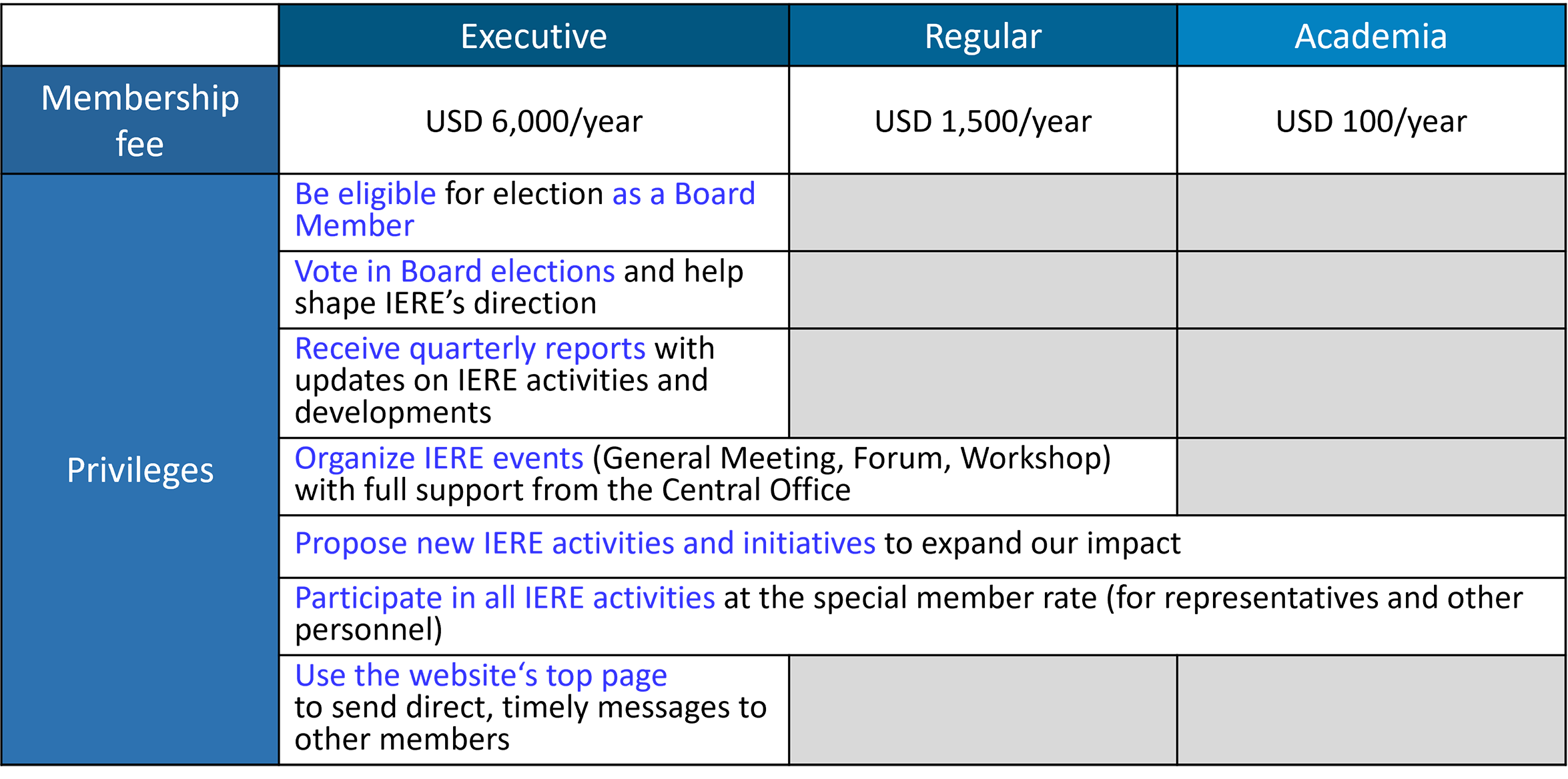
A. There are three membership categories: Executive members, Regular members, and Academic members. Please see the table below.
Q.
What are the eligibility requirements for membership?
A. In principle, eligibility is limited to corporations and organizations.
Q.
Since membership is corporate/institutional, can multiple individuals from the same organization participate under one membership?
A. Yes. Anyone belonging to a member organization can participate in IERE's activities.
Membership Application
Q.
How can my organization become a member?
A. Please complete and submit the membership application form, including information such as the representative of your organization, a contact person, and the reasons for applying. Once approved by the IERE Board, the Central Office will provide further guidance. For details, please see the “Join Us” page of the website.
Q.
Is there a review process for membership applications?
A. Yes. All applications are reviewed and approved by the IERE Board of Directors.
Membership Fees and Payment
Q.
How much is the membership fee, and how should it be paid?
A. The membership fee varies by category (e.g., Executive, Regular). Payment is made by bank transfer according to the invoice issued. Invoices are sent upon joining and again at the end of each year for the following year's annual fee.
Renewal and Withdrawal
Q.
How long is the membership valid?
A. Membership is renewed annually and continues automatically unless withdrawal is requested.
Q.
How can I update my membership information?
A. Members can update their information by contacting the Central Office directly.
Q.
How can my organization withdraw from membership?
A. Please notify the Central Office.
Main Activities of IERE
Focus Areas
Q.
In what fields does IERE mainly operate?
A. IERE focuses on technical development and research in the field of global electric power systems, with particular emphasis on information sharing, technology foresight, and fostering innovation.
Overview of Events
Q.
What are IERE's main events?
A. Key events include the General Meeting, Forums, Workshops, and Webinars.
Q.
What is the General Meeting?
A. The General Meeting is IERE’s principal annual event, where decisions of the Board and major activities are reported. It is usually held in conjunction with a Forum.
Q.
What is a Forum?
A. A Forum is a technical session held alongside the General Meeting, where participants discuss the latest technical challenges and R&D strategies from a global perspective.
Q.
What is a Workshop?
A. A Workshop is an international conference organized regionally, based on the needs of the host organization, to discuss technical and socio-economic issues.
Q.
What is a Webinar?
A. A Webinar is an online lecture by experts on the latest or requested topics, designed to facilitate broad information sharing.
Q.
What is a Mini-Workshop?
A. A Mini-Workshop is a small-scale online session focused on sharing field-based technical experiences and learning about the latest technologies.
Q.
What is the Technology Leaders Meeting (TLM)?
A. Held in 2014-2015, this small expert meeting reviewed strategic directions and led to the launch of the Technology Foresight initiative.
Overview of Projects
Q.
What are IERE's main projects?
A. The main projects include Technology Foresight and collaborative research Initiatives.
Q.
What is the Technology Foresight Project?
A. Launched in 2016, this project analyzes key emerging technologies and provides insights to support members' strategic planning.
Q.
What are Collaborative Research Projects?
A. These are collaborative activities where members share knowledge and resources to address common technical interests under the leadership of a project leader. Generally, there are no financial transactions involved; research is conducted on a give-and-take basis among participating members.
Q.
What is TIS (Technological Issues and Solutions)?
A. TIS is an initiative aimed at identifying and solving global technical challenges, primarily in Asia and Africa.
Events and Participation Guidelines
Event Schedule and Information
Q.
What events are held and how often?
A. The General Meeting and Forum are usually held once a year between September and November. Workshops are typically organized annually between April and June. Webinars and other events are held as needed. Please check “Events” section on the IERE website.
Q.
Where can I find information on upcoming events?
A. Event information is available on the IERE website and through INFORMAIL—information provided via email updates.
Participation in Events
Q.
How can I participate in IERE events?
A. Most events require advance registration through the IERE website.
Q.
Are the events free of charge?
A. Webinars are free of charge. In-person events (such as Forums and Workshops) require a participation fee to cover operating costs.
Q.
Is online participation or presentation possible?
A. Online participation and presentation are possible in Webinars. General Meetings, Forums, and Workshops are basically held in person; however, parts of these events may be streamed online in some cases.
Q.
Are event participation fees included in the membership fee?
A. No. Participation fees are charged separately for each event.
Q.
Can non-members also participate?
A. Most events are members-only. However, some events—such as Forums, Workshops, and selected Webinars—are open to non-members, and participation is welcomed.
Q.
Can I attend events as an audience member without giving a presentation?
A. Yes. Most events allow participation without a presentation.
Q.
Can I cancel after registering?
A. Yes. However, cancellation policies vary from event to event. Please check the announcement for each event.
Presentations at Events
Q.
How can I make a presentation at a Forum or Workshop?
A. Please follow the call for papers of each event and submit an abstract in advance. Accepted presenters will be notified after review.
Q.
What presentation formats are available?
A. Depending on the event, presentations may be oral or poster sessions.
Q.
What should I bring for my oral presentation at the event?
A. You do not need to bring any specific equipment. The presentation files you submit in advance will be installed on the venue PCs, which you will use for your presentation. If you need to make any revisions after submission, we will be happy to accommodate them.
Q.
What is the poster size for poster sessions?
A. Panels are generally prepared to accommodate A0 size ($841 \times 1,189 \text{ mm}$). Please check event-specific information, as requirements may vary.
Q.
Are oral and poster presentations peer-reviewed?
A. Presentations are reviewed in advance; however, they are not subject to a formal peer-review process. Please note that a presentation may be declined if its content violates public order or morals, or includes defamatory statements.
Q.
Can I present my company's technology?
A. Yes. Presentations at Forums, Workshops and Webinars are welcome as opportunities for knowledge sharing. However, since IERE is a non-profit organization, overly promotional presentations should be avoided.
Q.
Is English the official language for presentations?
A. Yes. Presentations are limited to English.
Q.
Is simultaneous interpretation provided?
A. Unfortunately, simultaneous interpretation is not usually available.
Q.
Is submission of presentation materials required?
A. Yes. Please submit your presentation materials in the specified format before the event.
Q.
Will presentation materials be made public?
A. With the presenter's consent, abstracts and slides (PDF format) will be posted on the website for participants and members. Abstracts are publicly available to non-members as well.
Q.
Will presentation videos be published?
A. Some videos, such as keynote speeches in Plenary Sessions, may be made available.
Q.
Can I see how the event was conducted?
A. Photos and videos of presentations and venues may be shared on the website and social media. Participants will be notified in advance.
Certificates of Participation
Q.
Are certificates of participation issued?
A. Yes. Certificates can be issued upon request.
Collaborative Research and Technology Foresight Projects
Project Information
Q.
Where can I find information about collaborative research projects?
A. Please refer to the following page: URL
Q.
Where can I find information about the Technology Foresight Project?
A. Please refer to the following page: URL
Q.
How are project themes decided?
A. Themes are selected based on proposals from members, with a focus on areas of strong interest.
How to Participate in Projects
Q.
Can I participate in IERE’s collaborative research projects?
A. Yes. Calls for participation are announced for each research theme. Interested members should notify the Central Office. Once participating members are confirmed, a project leader will be selected among them. The project begins after approval by the IERE Board.
Q.
Can non-members participate in collaborative projects?
A. Participation is generally limited to members. However, non-members may participate with the consent of the member organizations involved in the project.
How to Propose a Project
Q.
Can members propose collaborative research and development projects?
A. Yes. Members can propose new themes and launch projects jointly with other members. It is desirable to recommend a project leader (self-nominations are welcome).
Q.
Can members initiate new activities within IERE?
A. Yes. If there is a shared area of interest, members may propose new projects or activities. Please consult with the Secretariat.
Project Outcomes and Deliverables
Q.
What outcomes have been achieved in past projects?
A. Outcomes include reports on new methods for transformer lifetime assessment, applications of AI, battery energy storage, and preliminary studies on hydrogen technologies.
Q.
Are project results shared with members?
A. Yes. Final reports and presentation materials are distributed to members.
Q.
Are project results presented at academic conferences?
A. Yes. Some results are presented at academic conferences and published as papers.
Q.
How will the Technology Foresight Project evolve in the future?
A. It will continue as a core IERE activity, providing members with valuable insights and issuing reports on a regular basis based on member feedback.
Technology Transfer and Next-Generation Human Resource Development
Technology Transfer
Q.
Does IERE conduct technology transfer activities?
A. Yes. Through collaborative research projects and TIS activities, IERE promotes knowledge and technology sharing among its members.
Partnerships and Collaboration
Q.
Is it possible to co-host events or projects with other organizations?
A. Yes. Proposals will be considered depending on the content and objectives. Please contact the Central Office.
Q.
Does IERE collaborate with other organizations?
A. Yes. IERE has signed Memoranda of Understanding (MOUs) with academic societies and peer organizations. For a list of current MOU partners, please see “MOU Partners” section on “About Us” page.
Q.
Is a formal agreement required for partnerships?
A. Depending on the nature of the partnership, an MOU or an implementation agreement may be concluded. The process is usually coordinated through the Central Office and finalized after approval by the Board.
Support for Young Professionals and Researchers
Q.
Does IERE support young engineers?
A. Yes. IERE seeks to encourage interest in the energy and power sectors and contribute to developing the next generation of professionals.
Q.
Are there discounts for young researchers?
A. Student discounts are available for some events.
Publications, Materials, and Public Relations
Publications and Access to Archived Materials
Q.
What information is made available?
A. Members have access to information such as event records—including abstracts, slides, and videos—reports from collaborative research and Technology Foresight projects, and membership-related information.
Q.
Can I view past events, projects, newsletters, or annual reports?
A. Yes. Members can access archived materials. Some of this information is also available to the public. Please use the keyword search function on the website.
Information Services
Q.
What information channels does IERE provide?
A. In addition to information published on the website, IERE distributes content through the Newsletter and INFORMAIL.
Q.
Can I receive updates on upcoming events?
A. Yes. Members receive regular newsletters and event updates. Non-members who subscribe can receive selected event information through the INFORMAIL service.
Q.
What is INFORMAIL?
A. INFORMAIL is IERE's email service that delivers information to registered recipients, regardless of membership status.
Q.
How can I subscribe to INFORMAIL?
A. Please subscribe via the IERE website. Distribution will begin automatically after registration. To unsubscribe, you may either send a blank email to the address provided at the end of any INFORMAIL message.
Q.
Can anyone read the Newsletter?
A. All issues are accessible to members on the website. In addition, contact persons registered with member organizations receive newsletters by email upon publication.
Use of Logo and Materials / Media Inquiries
Q.
Can I use IERE's logo or official materials?
A. Unauthorized use is not permitted. Please contact the Central Office in advance to obtain approval.
Q.
Can I use IERE materials within another organization?
A. Unauthorized reproduction is prohibited. Please contact the Central Office for permission.
Q.
How can media representatives contact IERE?
A. Media inquiries and interview requests should be directed to the Central Office via the contact information listed on the website.
Web Access
Web Access
Q.
I cannot access members-only contents. What should I do?
A. If your organization is an IERE member, you can access it using your membership ID and password. Your member ID is the email address issued by your affiliated organization. Please enter your email address via the website instructions and create your own password. If you still have trouble, please contact us via the “Contact” page.
Q.
What should I do if I forget my website login Password?
A. You can reset it in the “Password Reset” page. If the process does not work, please contact us via the “Contact” page.
Join Us
Interested in IERE membership?
See the available options and how to apply.
Contact
Questions or proposals? We welcome your message.
Please also check our FAQ.